

Coaxlink Quad CXP-3
Four-connection CXP-3 CoaXPress frame grabber

Main > Product > Frame Grabbers & Interface Cards > CoaXpress Frame Grabber > Euresys Coaxlink Series > Coaxlink Quad CXP-3
Coaxlink Quad CXP-3
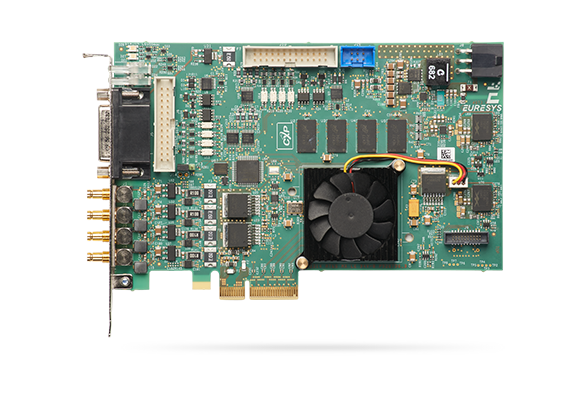
At a glance
- Four CoaXPress CXP-3 connections: 1,250 MB/s camera bandwidth
- Connect four cameras to one card
- Works with extra-long camera cables (100+ meters)
- PCIe 2.0 (Gen 2) x4 bus: 1,700 MB/s delivery bandwidth
- Extensive camera control functions
- Memento Event Logging Tool
Benefits
- Long cable support: 100+ meters Use standard coaxial cables
- Robust connectors for reliable connections
- Connect up to 4 cameras to a single Coaxlink card
- Memento Event Logging Tool
- Direct GPU transfer
- PCIe 2.0 (Gen 2) x4 bus
- General purpose I/O lines
- High-performance DMA (Direct Memory Access)
- Area-scan triggering capabilities
- Compatible with eGrabber
- Compliant with Genicam
- Windows, Linux and macOS drivers available
Applications
- Machine Vision for the Electronic Manufacturing Industry
- Machine Vision for the General Manufacturing Industries
- Video Acquisition and Recording
- Video Monitoring, Surveillance & Security

| Model | Coaxlink Quad CXP-3 |
|---|---|
| Mechanical | |
| Format | Standard profile, half length, 4-lane PCI Express card |
| Cooling method | Air cooling, fan-cooled heatsink |
| Mounting | For insertion in a standard height, 4-lane or higher, PCI Express card slot |
| Connectors | • 'A', 'B', 'C', 'D' on bracket: – 4x DIN 1.0/2.3 female connectors – CoaXPress host interface • 'EXTERNAL I/O' on bracket: – 26-pin 3-row high-density female sub-D connector – I/O lines and power output • 'INTERNAL I/O 1' and 'INTERNAL I/O 2' on PCB: – 2x 26-pin 2-row 0.1" pitch pin header with shrouding – I/O lines and power output • 'AUXILIARY POWER INPUT' on module: – 6-pin PEG power socket – 12 VDC power input for PoCXP camera(s) and I/O power • 'C2C-LINK' on module: – 6-pin 2-row 0.1-in header – Card to card link |
| LED indicators | • 'A', 'B', 'C', 'D' on bracket: – Bi-color red/green LEDs – CoaXPress Host connector indicator • 'FPGA STATUS LAMP' on PCB: – Bi-color red/green LED – FPGA status indicator • 'BOARD STATUS LAMP' on PCB: – Bi-color red/green LED – Board status indicator |
| Switches | 'RECOVERY' on card PCB: • 3-pin 1-row 0.1" header • Firmware emergency recovery |
| Dimensions | L 167.65 mm x H 111.15 mm L 6.6 in x H 4.38 in |
| Weight | 170 g, 6.00 oz |
| Host bus | |
| Standard | PCI Express 2.0 |
| Link width | • 4 lanes • 1 lane or 2 lanes with reduced performance |
| Link speed | • 5.0 GT/s (PCIe 2.0) • 2.5 GT/s (PCIe 1.0) with reduced performance |
| Maximum payload size | 512 bytes |
| DMA | 32- and 64-bit |
| Peak delivery bandwidth | 2,000 MB/s |
| Effective (sustained) delivery bandwidth | 1,700 MB/s (Host PC motherboard dependent) |
| Power consumption | Typ. 12.1W ( 2.5 W @ +3.3V, 9.6 W @ +12V), excluding camera and I/O power output |
| Camera / video inputs | |
| Interface standard(s) | CoaXPress 1.0, 1.1 and 1.1.1 |
| Connectors | Four DIN1.0/2.3 75 Ohms CXP-3 |
| Status LEDs | One CoaXPress Host connection status LED per connection |
| Number of cameras | Up to four 1-connection cameras |
| Maximum aggregated camera data transfer rate | 12.5 Gbit/s (1,250 MB/s) |
| Supported CXP down-connection speeds | 1.25 GT/s (CXP-1), 2.5 GT/s (CXP-2), 3.125 GT/s (CXP-3) |
| Number of CXP data streams (per camera) | 1 data stream per camera |
| Maximum CXP stream packet size | 8,192 bytes |
| Camera types | • Grayscale • Color (RGB and Bayer CFA) |
| Camera pixel formats supported | Raw, Monochrome, Bayer, RGB, and RGBA (PFNC names): • Raw • Mono8, Mono10, Mono12, Mono14, Mono16 • BayerXX8, BayerXX10, BayerXX12, BayerXX14, BayerXX16 where XX = GR, RG, GB, or BG • RGB8, RGB10, RGB12, RGB14, RGB16 • RGBA8, RGBA10, RGBA12, RGBA14, RGBA16 • YCbCr601_422_8, YCbCr601_422_10 • YCbCr709_422_8, YCbCr709_422_10 • YUV422_8, YUV422_10 |
| Area-scan camera control | |
| Trigger | • Precise control of asynchronous reset cameras, with exposure control. • Support of camera exposure/readout overlap. • Support of external hardware trigger, with optional delay and trigger decimation. |
| Strobe | • Precise control of asynchronous reset cameras, with exposure control. • Support of camera exposure/readout overlap. • Support of external hardware trigger, with optional delay and trigger decimation. |
| Line-scan camera control | |
| Line trigger | • Precise control of asynchronous reset cameras, with exposure control. • Support of camera exposure/readout overlap. • Support of external hardware trigger, with optional delay and trigger decimation. |
| Line strobe | • Accurate control of the strobe position for strobed light sources. • Support of early and late strobe pulses. |
| On-board processing | |
| On-board memory | 1 GB |
| Image data stream processing | • Unpacking of 10-/12-/14-bit to 16-bit with selectable justification to LSb or MSb • Optional swap of R and B components • Little endian conversion |
| Data stream statistics | • Measurement of: – Frame rate (Area-scan only) – Line rate – Data rate • Configurable averaging interval |
| Event signaling and counting | • The application software can be notified of the occurrence of various events: – Standard event: the EVENT_NEW_BUFFER event notifies the application of newly filled buffers – A large set of custom events • Custom events sources: – I/O Toolbox events – Camera and Illumination control events – CoaXPress data stream events – CoaXPress host interface events • Each custom event is associated with a 32-bit counter that counts the number of occurrences • The last three 32-bit context data words of the event context data can be configured with event-specific context data: – Event-specific data – State of all System I/O lines sampled at the event occurrence time – Value of any event counter |
| General Purpose Inputs and Outputs | |
| Number of lines | 20 I/O lines: • 4 differential inputs (DIN) • 4 singled-ended TTL inputs/outputs (TTLIO) • 8 isolated inputs (IIN) • 4 isolated outputs (IOUT) |
| Usage | • Any I/O input lines can be used by any LIN tool of the I/O Toolbox • Selected pairs of I/O input lines can be used by any QDC tool of the I/O toolbox to decode A/B signals of a motion encoder • The LIN and QDC tools outputs can be further processed by the other tools (DIV, MDV, DEL) of the I/O toolbox to generate any of the following "trigger" events: – The "cycle trigger" of the Camera and Illumination controller – The "cycle sequence trigger" of the Camera and Illumination controller – The "start-of-scan trigger" of the Acquisition Controller (line-scan only) – The "end-of-scan trigger" of the Acquisition Controller (line-scan only) |
| Electrical specifications | • DIN: High-speed differential inputs compatible with ANSI/EIA/TIA-422/485 differential line drivers and complementary TTL drivers • TTLIO: High-speed 5V-compliant TTL inputs or LVTTL outputs, compatible with totem- pole LVTTL, TTL, 5V CMOS drivers or LVTTL, TTL, 3V CMOS receivers • IIN: Isolated current-sense inputs with wide voltage input range up to30V, compatible with totem-pole LVTTL, TTL, 5V CMOS drivers, RS-422 differential line drivers, potential free contacts, solid-state relays and opto-couplers • IOUT: Isolated contact outputs compatible with 30V / 100mA loads |
| Filter control | • Glitch removal filter available on all System I/O input lines • Configurable filter time constants: – for DIN and TTLIO lines: 50 ns, 100 ns, 200 ns, 500 ns, 1 μs – for IIN lines: 500 ns, 1 μs, 2 μs, 5 μs, 10 μs |
| Polarity control | Yes |
| Power output | Non-isolated, +12V, 1A, with electronic fuse protection |
| I/O Toolbox tools | The I/O Toolbox is a configurable interconnection of tools that generates events (usually triggers) from input lines. The composition of the toolset is product- and firmware- dependent. • Line Input tool (LIN): Edge detector delivering events on rising or falling edges of any selected input line. • Quadrature Decoder tool (QDC): A composite tool including: – A quadrature edge detector delivering events on selected transitions of selected pairs of input lines. – An optional backward motion compensator for clean line-scan image acquisition when the motion is unstable. – A 32-bit up/down counter for delivering a position value. • Divider tool (DIV): to generate an event every nth input events from any I/O toolbox event source. • Delay tool (DEL): to delay up to 16 events from one or two I/O toolbox event sources, by a programmable time or number of motion encoder ticks (any QDC events). |
| I/O Toolbox composition | 8 LIN, 1 QDC, 1 DIV, 1 DEL |
| C2C-Link | |
| Description | • Accurate synchronization of the trigger and the start-of-exposure of multiple grabber- controlled area-scan cameras. • Accurate synchronization of the start-of-cycle, start-of-scan and end-of-scan of multiple grabber-controlled line-scan cameras. |
| Specification | • C2C-Link synchronizes cameras connected to: – the same card – to different cards in the same PC (requires an accessory cable such as the "3303 C2C- Link Ribbon Cable" or a custom-made C2C-Link cable) – to different cards in different PCs (requires one "1636 InterPC C2C-Link Adapter" for each PC and one RJ 45 CAT 5 STP straight LAN cable for each adapter but the last one) • Maximum distance: – 60 cm inside a PC – 1200 m cumulated adapter to adapter cable length • Maximum trigger rate: – 2.5 MHz for configurations using a single PC, or up to 10 PCs and 100 m total C2C-Link cable length – 200 kHz for configurations up to 32 PCs and 1200m total C2C-Link cable length • Trigger propagation delay from master to slave devices: – Less than 10 ns for cameras on the same card or on different cards in the same PC – Less than 265 ns for cameras on different cards in different PCs (3 PCs and 40m total C2C-Link cable length) |
| Software | |
| Host PC Operating System | • Microsoft Windows 10, 8.1, 7 for x86 (32-bit) and x86-64 (64-bit) processor architectures • Linux for x86 (32-bit), x86-64 (64-bit) and aarch64 (64-bit) processor architectures • macOS for x86-64 (64-bit) processor architecture |
| APIs | EGrabber class, with C++ and .NET APIs: • .NET assembly designed to be used with development environments compatible with .NET frameworks version 4.0 or higher GenICam GenTL producer libraries compatible with C/C++ compilers: • x86 dynamic library designed to be used with ISO-compliant C/C++ compilers for the development of x86 applications • x86_64 dynamic library designed to be used with ISO-compliant C/C++ compilers for the development of x86_64 applications • aarch64 dynamic library designed to be used with ISO-compliant C/C++ compilers for the development of aarch64 applications |
| Environmental conditions | |
| Operating ambient air temperature | 0 to +55 °C / +32 to +131 °F |
| Operating ambient air humidity | 10 to 90% RH non-condensing |
| Storage ambient air temperature | -20 to +70 °C/ -4 to +158 °F |
| Storage ambient air humidity | 10% to 90% RH non-condensing |
| Certifications | |
| Electromagnetic - EMC standards | • European Council EMC Directive 2004/108/EC • United States FCC rule 47 CFR 15 |
| EMC - Emission | • EN 55022:2010 Class B • FCC 47 Part 15 Class B |
| EMC - Immunity | • EN 55024:2010 Class B • EN 61000-4-3 • EN 61000-4-4 • EN 61000-4-5 • EN 61000-4-6 |
| Flammability | PCB compliant with UL 94 V-0 |
| KC Certification | Korean Radio Waves Act, Article 58-2, Clause 3 |
| RoHS | European Union Directive 2015/863 (ROHS3) |
| REACH | European Union Regulation 1907/2006 |
| WEEE | Must be disposed of separately from normal household waste and must be recycled according to local regulations |