

Coaxlink QSFP28
100G CoaXPress-over-Fiber frame grabber
Main > Product > Frame Grabbers & Interface Cards > CoaXPress Frame Grabber > Euresys Coaxlink Series > Coaxlink QSFP28
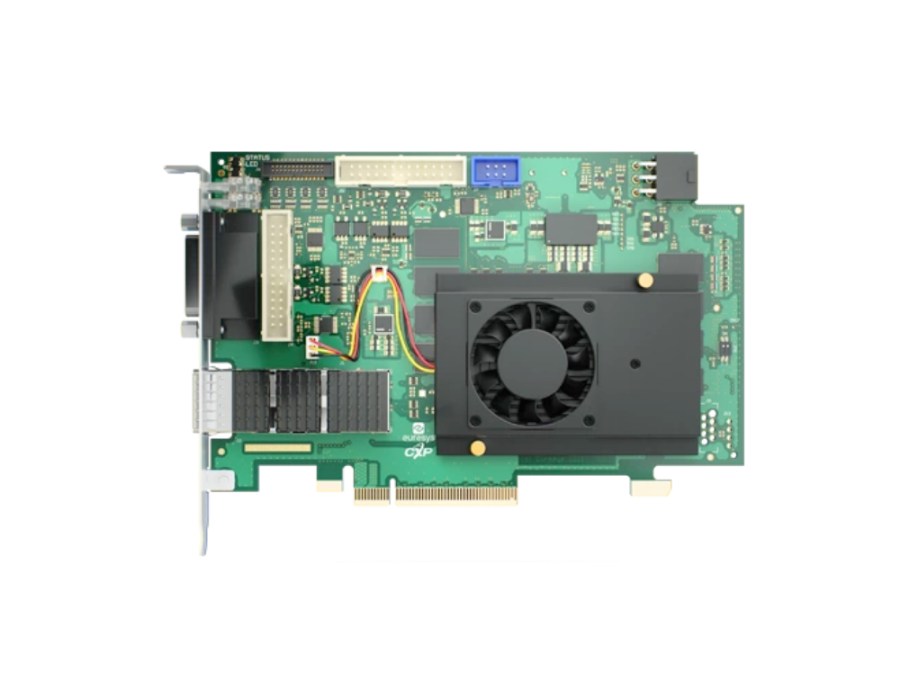
Coaxlink QSFP28
The highlight features
- One QSFP28 port compliant with 100 Gbps optical modules
- Four-connection 25 Gbps CoaXPress-over-Fiber
- 12,500 MB/s camera bandwidth
- 8 GB of on-board memory
- PCIe 4.0 (Gen 4) x8 bus: 13,500 MB/s bus bandwidth
- Feature-rich set of 20 digital I/O lines
- Extensive camera control functions
- Memento Event Logging Tool
By using fiber optics connectivity, CoaXPress-over-Fiber benefits from the almost unlimited cable lengths and reduced cable congestion (fiber optics are lighter and thinner than coaxial cables). By leveraging Ethernet Physical Layer standards (IEEE 802.3), CoaXPress-over-Fiber also benefits from the low-cost standard components (such as connectors and cables) and their constant evolution towards higher bandwidths. Most importantly, CoaXPress-over-Fiber allows CoaXPress to go beyond the physical limitations of coaxial cables in terms of bitrate.

| Model | Coaxlink QSFP28 |
|---|---|
| Form factor | PCI Express card |
| Format | Standard profile, half length, 8-lane PCI Express card |
| Cooling method | Air cooling, fan-cooled heatsink |
| Mounting | For insertion in a standard height, 8-lane or higher, PCI Express card slot |
| Connectors | QSFP28' on card bracket: 'EXTERNAL I/O' on card bracket: 'INTERNAL I/O 1' on printed circuit board: 'INTERNAL I/O 2' on printed circuit board: 'I/O EXTENSION' on printed circuit board: 'C2C-LINK' on printed circuit board: 'AUXILIARY POWER INPUT' on printed circuit board: |
| LED indicators | 'A', 'B', 'C', 'D' on bracket: 'FPGA STATUS LAMP' on PCB: BOARD STATUS LAMP' on PCB: |
| Switches | 'RECOVERY' on PCB: |
| Dimensions | PCB L x H: 167.65 mm x 111.15 mm [6.6 in x 4.38 in] |
| Weight | Net weight: 210 g [7.4 oz] Gross weight: 310 g [10.9 oz] |
| Standard | PCI Express 4.0 |
| Link width | 8 lanes 1 lane, 2 lanes or 4 lanes with reduced performance |
| Link speed | 16.0 GT/s (PCIe 4.0) |
| Maximum payload size | 512 bytes |
| DMA | 32- and 64-bit |
| Peak delivery bandwidth | 15,700 MB/s |
| Effective (sustained) delivery bandwidth | 13,500 MB/s (Host PC motherboard dependent) |
| Power consumption | Typ. 30.64 W ( 0.04 W @ +3.3V, 30.6 W @ +12V), excluding I/O power output and optical transceiver module |
| Camera interface standard | CoaXPress |
| Interface standard(s) | CoaXPress 1.0, 1.1, 1.1.1, 2.0, 2.1, CoaXPress-over-Fiber Bridge Protocol 1.1 |
| Maximum link speed | CXP-31 |
| Maximum link width | 4 connections |
| Connectors | 1. QSFP+ 28Gb/s 4X Pluggable Transceiver (QSFP28) port 2. Compliant with CoaXPress-over-Fiber 3. Available power for the module: 5 W (SFF-8436 Power class 7) |
| Status LEDs | One CoaXPress Host connection status LED per connection |
| Number of cameras | Area-scan cameras: One 1- or 2- or 4-connection camera Line-scan cameras: One 1- or 2- or 4-connection camera |
| Maximum number of cameras | 1 |
| Line-scan cameras supported | Yes |
| Maximum aggregated camera data transfer rate | 100 Gbps (12,500 MB/s) |
| Supported CXP down-connection speeds | 25 Gbps (CXP-31) |
| Supported CXP up-connection speeds | Low-speed 20.83... Mbps (Device discovery) Low-speed 41.66... Mbps (CXP-31) |
| Number of CXP data streams (per camera) | 1 data stream per camera |
| Maximum CXP stream packet size | 16,384 bytes |
| Camera types | Area-scan cameras: 1. Grayscale and color (YCbCr, YUV, RGB and Bayer CFA) 2. Single-tap (1X-1Y) progressive-scan 3. Two-tap (1X-2YE) on two distinct data streams Line-scan cameras and contact imaging sensors: 1. Grayscale and color RGB |
| Camera pixel formats supported | 1. Mono8, Mono10, Mono12, Mono14, Mono16 2. BayerXX8, BayerXX10, BayerXX12, BayerXX14, BayerXX16 where XX = GR, RG, GB, or BG 3. RGB8, RGB10, RGB12, RGB14, RGB16 4. RGBA8, RGBA10, RGBA12, RGBA14, RGBA16 5. YCbCr601_422_8, YCbCr601_422_10 6. YCbCr709_422_8, YCbCr709_422_10 7. YUV422_8, YUV422_10 8. Raw |
| Area-scan camera control | |
|---|---|
| Trigger | 1. Precise control of asynchronous reset cameras, with exposure control. 2. Support of camera exposure/readout overlap. 3. Support of external hardware trigger, with optional delay and trigger decimation. |
| Strobe | 1. Accurate control of the strobe position for strobed light sources. 2. Support of early and late strobe pulses. |
| Line-scan camera control | |
|---|---|
| Scan/page trigger | 1. Precise control of start-of-scan and end-of-scan triggers. 2. Support of external hardware trigger, with optional delay. 3. Support of infinite acquisition, without missing line, for web inspection applications. |
| Line trigger | 1. Support for quadrature motion encoders, with programmable noise filters, selection of acquisition direction and backward motion compensation. 2. Rate Converter tool for fine control of the pixel aspect ratio: Rate Conversion Ratio in the range 0.001 to 1000 with an accuracy better than 0.1%. 3. Rate Divider tool |
| Line strobe | Accurate control of the strobe position for strobed light sources. |
| On-board memory | 4 GB |
| Image data stream processing | 1. Unpacking of 10-/12-/14-bit to 16-bit with selectable justification to LSb or MSb 2. Optional swap of R and B components 3. Little endian conversion |
| Data stream statistics | Measurement of: 1. Frame rate (Area-scan only) 2. Line rate 3. Data rate 4. Configurable averaging interval |
| Number of lines | 20 I/O lines: 1. 4 differential inputs (DIN) 2. 4 singled-ended TTL inputs/outputs (TTLIO) 3. 8 isolated inputs (IIN) 4. 4 isolated outputs (IOUT) NOTE: The number of I/O lines can be extended using I/O modules attached to the I/O EXTENSION connector. |
| Usage | 1. Any I/O input lines can be used by any LIN tool of the I/O Toolbox 2. Selected pairs of I/O input lines can be used by any QDC tool of the I/O toolbox to decode A/B signals of a motion encoder |
| Electrical specifications | 1. DIN: High-speed differential inputs, up to 5 MHz, compatible with ANSI/EIA/TIA-422/485 differential line drivers and complementary TTL drivers 2. TTLIO: High-speed 5V-compliant TTL inputs or LVTTL outputs, compatible with totem-pole LVTTL, TTL, 5V CMOS drivers or LVTTL, TTL, 3V CMOS receivers 3. IIN: 200 kHz isolated current-sense input with wide voltage input range up to 30V, compatible with totem-pole (push-pull) HTL drivers, 5V TTL/RS-422 differential line drivers, 5V CMOS drivers, potential free contacts, solid-state relays and opto-couplers 4. IOUT: Isolated contact outputs compatible with 30V / 100mA loads NOTE: IIN and IOUT lines provide a functional isolation grade for the circuit technical protection. It does not provide an isolation that can protect a human being from electrical shock! |
| Filter control | 1.Glitch removal filter available on all System I/O input lines 2. Configurable filter delay: - Custom value - Fixed values for DIN and TTLIO lines: 50 ns, 100 ns, 200 ns, 500 ns, 1 µs - Fixed values for IIN lines: 500 ns, 1 µs, 2 µs, 5 µs, 10 µs |
| Polarity control | Yes |
| Power output | Non-isolated, +12V, 1A, with electronic fuse protection |
| I/O Toolbox tools | The I/O Toolbox is a configurable interconnection of tools that generates events (usually triggers): Line Input tool (LIN): edge detector delivering events on rising or falling edges of any selected input line. Quadrature Decoder tool (QDC): a composite tool including: - A quadrature edge detector delivering events on selected transitions of selected pairs of input lines. - An optional backward motion compensator for clean line-scan image acquisition when the motion is unstable. - A 32-bit up/down counter for delivering a position value. 1. Device Link Trigger tool (DLT): delivers an event on reception of a valid high-speed CoaXPress 2.0 connection trigger packet message from the remote device. 2. User Actions Scheduler tool (UAS): to delegate the execution of 'User Actions' at a scheduled time or encoder position. Possible user actions include setting low/high/toggle any bit of the User Output Register or generation of any User Events. 3. Delay tool (DEL): to delay up to 16 events from one or two I/O toolbox event sources, by a programmable time or number of motion encoder ticks (any QDC events). 4. Divider tool (DIV): to generate an event every nth input events from any I/O toolbox event source. 5. Multiplier/divider tool (MDV): to generate m events every d input events from any I/O toolbox event source. The 'Input Tools' (LIN, QDC, DLT and UAS) can be further processed by the 'Event Tools' (DEL, DIV and MDV) to generate any of the following "trigger" events: - The "cycle trigger" of the Camera and Illumination controller - The "cycle sequence trigger" of the Camera and Illumination controller - The "start-of-scan trigger" of the Acquisition Controller (line-scan only) - The "end-of-scan trigger" of the Acquisition Controller (line-scan only) |
| I/O Toolbox composition | Determined by the selected firmware variant: 1. '1-camera': 8 LIN, 1 QDC, 2 DLT, 1 UAS, 2 DEL, 1 DIV, 1 MDV, 2 C2C 2. '1-camera, line-scan': 8 LIN, 1 QDC, 2 DLT, 1 UAS, 2 DEL, 1 DIV, 1 MDV, 3 C2C |
| C2C-Link | |
| Description | Accurate synchronization of the trigger and the start-of-exposure of multiple grabber-controlled area-scan cameras. Accurate synchronization of the start-of-cycle, start-of-scan and end-of-scan of multiple grabber-controlled line-scan cameras. |
| Specification | C2C-Link synchronizes cameras connected to: the same card to different cards in the same PC (requires an accessory cable such as the "3303 C2C-Link Ribbon Cable" or a custom-made C2C-Link cable) to different cards in different PCs (requires one "1636 InterPC C2C-Link Adapter" for each PC and one RJ 45 CAT 5 STP straight LAN cable for each adapter but the last one) Maximum distance: 120 cm inside a PC 1200 m cumulated adapter to adapter cable length Maximum trigger rate: 2.5 MHz for configurations using a single PC, or up to 10 PCs and 100 m total C2C-Link cable length 200 kHz for configurations up to 32 PCs and 1200m total C2C-Link cable length Trigger propagation delay from master to slave devices: Less than 10 ns for cameras on the same card or on different cards in the same PC Less than 265 ns for cameras on different cards in different PCs (3 PCs and 40m total C2C-Link cable length) |
| Software | |
| Driver name | eGrabber |
| First release | eGrabber 25.10 |
| Current release | eGrabber 25.12 |
| Host PC Operating System | Microsoft Windows 11, 10 for x86-64 (64-bit) processor architecture Linux for x86-64 (64-bit) and AArch64 (64-bit) processor architectures macOS for x86-64 (64-bit) and AArch64 (64-bit) processor architectures |
| APIs | EGrabber class, with C++ and .NET APIs: .NET assembly designed to be used with development environments compatible with .NET frameworks version 4.6 or higher GenICam GenTL producer libraries compatible with C/C++ compilers: 'x86_64' dynamic library designed to be used with ISO-compliant C/C++ compilers for the development of x86-64 (64-bit) applications 'aarch64' dynamic library designed to be used with ISO-compliant C/C++ compilers for the development of AArch64 (64-bit) applications |
| Memento supported | Yes |
| Environmental conditions | |
| Operating ambient air temperature | 0°C to +55°C / +32°F to +131°F |
| Operating ambient air humidity | 10% to 90% RH non-condensing |
| Storage ambient air temperature | -20°C to +70°C/ -4°F to +158°F |
| Storage ambient air humidity | 10% to 90% RH non-condensing |
| Certifications | |
| EMC standards | European Council EMC Directive 2014/30/EU United States FCC CFR Title 47 Part 15B |
| EMC - Emission | EN 55032:2015 + A11:2020 (harmonized standard) / CISPR 32:2015 + A1:2019 Class B FCC CFR Title 47 Part 15B Class B |
| EMC - Immunity | EN 55035:2017 + A11:2020 (harmonized standard) / CISPR 35:2016 EN 61000-6-2:2019 / IEC 61000-6-2:2016 EN 61000-6-2:2005 (harmonized standard) |
| KC Certification | Korean Radio Waves Act, Article 58-2, Clause 3 |
| Flammability | PCB compliant with UL 94 V-0 |
| RoHS | European Union Directive 2015/863 (ROHS3) |
| WEEE | Must be disposed of separately from normal household waste and must be recycled according to local regulations |